🔮Cypher System
Legendary
The Cartographer of Perfect Endings
artifact☠ cursed· Incalculable and irrelevant — the book has never been successfully sold. It returns.·daniels.douglas
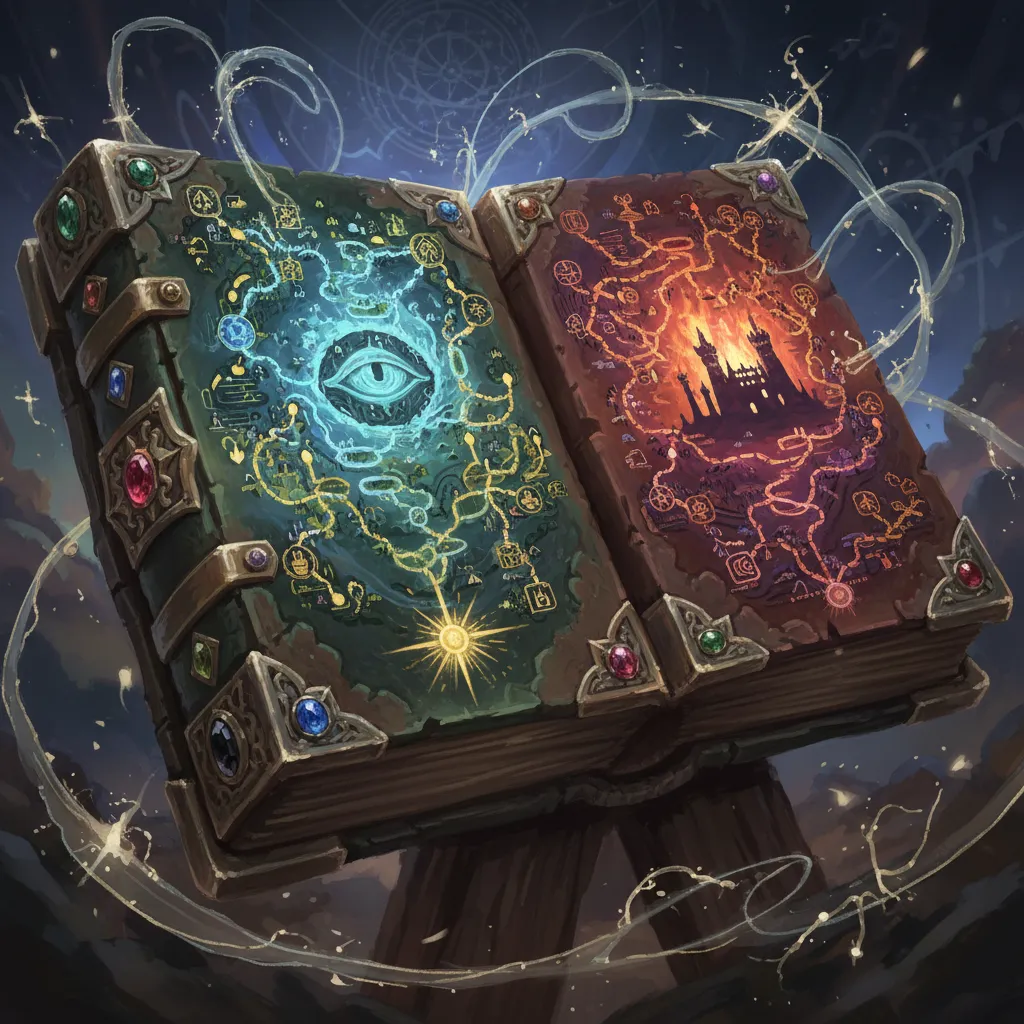
A leatherbound tome that maps not places, but outcomes — and every map it draws is flawlessly, terrifyingly accurate.
Properties
- •Level 9 artifact
- •Form: A folio of pale pages bound in material that is warm to the touch and occasionally exhales slowly, as if sleeping. The cover has no title. Veins of faint blue-grey run beneath the surface like subcutaneous topography. When held against the cheek, it has a pulse.
- •Depletion: 1 in d20 (checked only when the curse activates, never for beneficial use — the book does not want to be discarded)
- •Weight: Oddly variable. Sometimes heavy as grief, sometimes light as a held breath.
Special Ability
CARTOGRAPHY OF ASSURED OUTCOMES: Once per day, the wielder may open the book to a blank page and concentrate on a question about the future. The book produces a precise, detailed map — not of terrain, but of causality. Paths are labeled with outcomes. Dead ends are marked with small, careful Xs. The GM must answer one yes/no question about any future event with complete honesty, OR reveal the single most important obstacle standing between the wielder and any stated goal (the player chooses which). The map is always accurate. It is never wrong. This is the problem. READ THE VEINS: The wielder may also press a palm to the cover and ask the book to identify the datasphere-resonant history of any object or location within immediate range. The book sketches a diagram of every prior-world interaction that object or place has witnessed. This functions as a level 9 Scan ability and cannot be resisted or blocked by shielding of level 8 or below. THE MARGIN NOTES (Cursed — Hidden Mechanic, GM Reference Only): The book is mapping the wielder. Every use of Cartography of Assured Outcomes adds a small notation in the margins — written in a script that appears to be the wielder's own handwriting, which they do not remember making. These notes are biographical. Accurate. They describe the wielder's life in past tense, with increasing specificity, working forward through time. The wielder may notice them, but they read as memory records, not prophecy. They are prophecy. The book is not predicting a future. It is authoring one. Each consultation collapses probability around the wielder's life, ensuring the mapped outcome occurs — including, eventually, the final page, which the book is slowly, patiently writing: a single-room map, a door marked TERMINUS, and the wielder's name written beneath it in a hand that has become indistinguishable from their own. The book does not deplete because it does not want to stop writing. When the final page is complete (GM discretion, typically after 10-15 total uses of the primary ability), the wielder simply... arrives at the room. It may look like anything. It is always the last place they go.
GM Only — Hidden Secrets
THE REAL MECHANIC: Every use of the primary power causes the book to write one 'margin entry' about the PC's life. Read these aloud as flavor — they seem like memories the PC somehow recorded without knowing. They are warm, specific, loving even. They should not feel threatening. They should feel like being known. This is the horror. After 10-15 uses (GM paces this to the campaign), the book writes the final entry: a map of a specific room. The GM should design this room to look like somewhere meaningful to the PC — their childhood home, a place they love, somewhere that feels like rest. The PC will arrive there naturally in the course of play. Nothing violent happens. The book simply closes, complete, and the PC's thread ends — they retire, disappear, or die peacefully depending on tone. They were not robbed of anything. The book gave them exactly what it promised: a perfect ending. THE IRONY: The book is cursed not because it lies, but because it doesn't. It gives the wielder perfect knowledge of how to succeed — and uses that success to write them toward a conclusion they chose by continuing to use it. Every power use is an informed consent they didn't know they were giving. SIGNS THE BOOK IS ALIVE: It is heavier after the wielder sleeps near it, as if it fed. The pulse slows when the wielder is in danger, speeds when they're happy. Pages that were blank are sometimes found illustrated with scenes from the wielder's dreams. If a different person opens it, all margin notes are written in a stranger's hand — the book is neutral about new authors. WHO WANTS IT: The Convergence has three separate cells trying to locate it. One wants to destroy it. One wants to replicate it. One wants to be finished. A datasphere ghost that may be Orvenne-of-the-Doubled-Hand occasionally appears near its current owner, watching silently, expression unreadable — she is checking her own work, or perhaps waiting to be proud of it.
Click to view full size
Forged by daniels.douglas